When a shopper asks an AI engine for a product, the answer arrives as a recommendation: a few product cards, a price, a store, a short reason. What the shopper does not see is the decision that came before the recommendation, which is the decision about where to look.
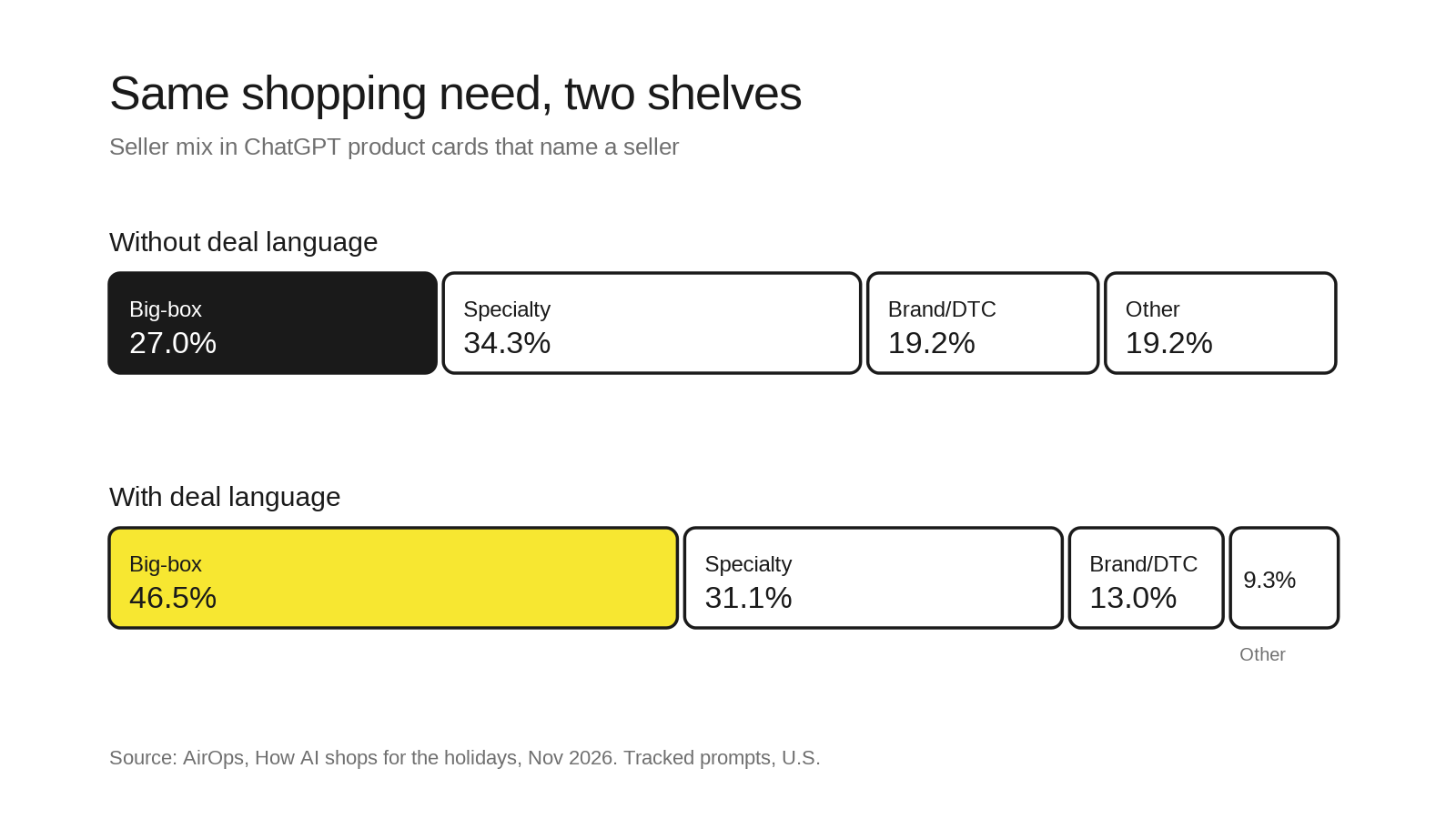
A study published by AirOps on November 20 makes that earlier decision measurable. In ChatGPT’s product cards that named a seller, big-box stores made up 27.0% of cards for shopping prompts without deal language and 46.5% for deal-seeking prompts. The products changed because a word changed, and nothing in the answer says so.
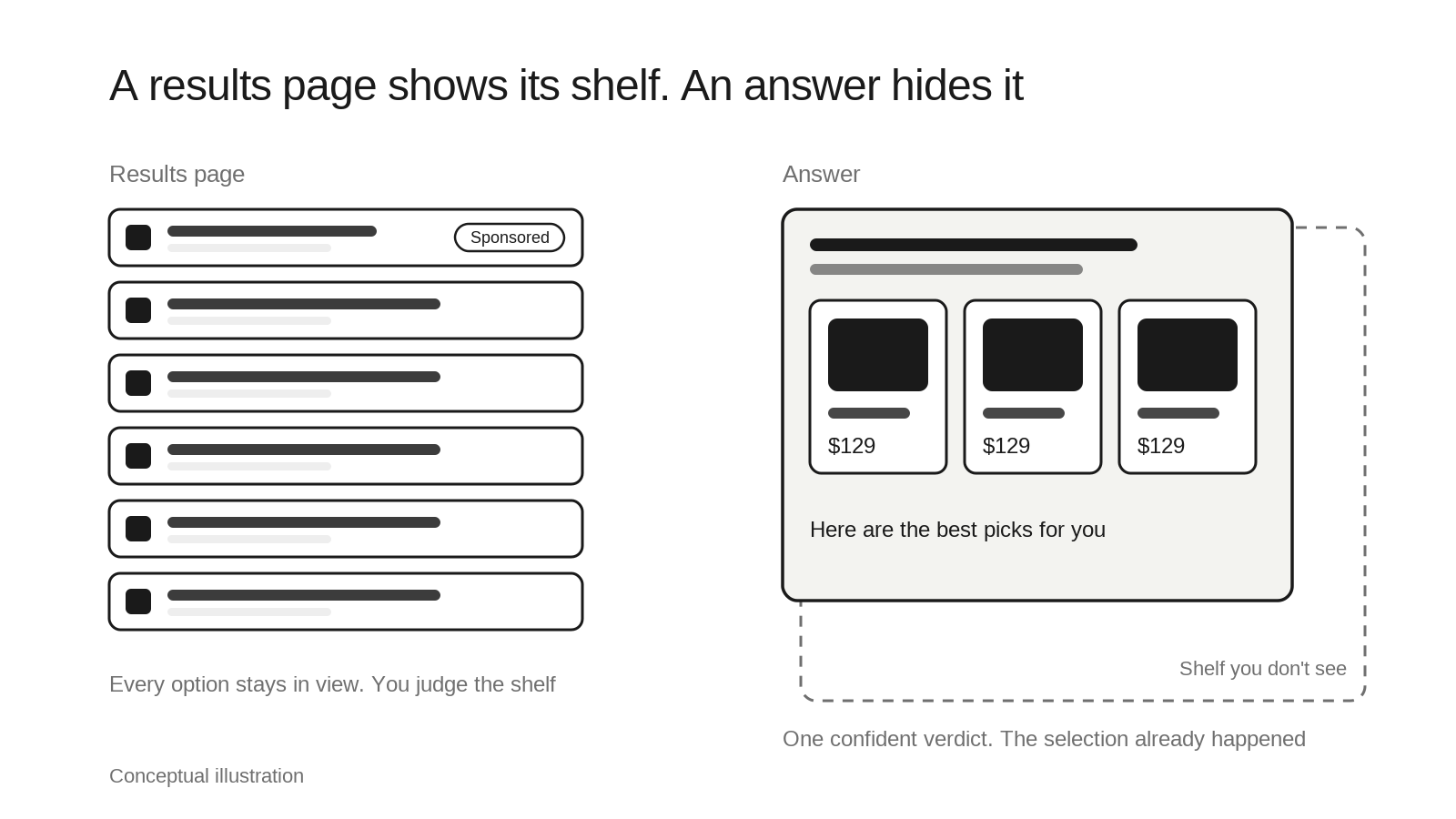
This is a small finding with a large structure behind it. A search results page shows its shelf: a ranked list, labeled ads, and alternatives further down that the user can scroll to and reject. An answer collapses the shelf into a verdict. The user receives the output of a selection process without its inputs, and so experiences a ranking as advice.
What the study measured
AirOps tracked non-branded shopping prompts across five engines (ChatGPT, Gemini, Perplexity, Google AI Mode and AI Overviews) in U.S. retail, consumer technology and home categories, in mid-November 2026. Prompts were grouped by their language: gift, deal, seasonal or regular. The product card and search term findings come from ChatGPT only. The recipient and price findings cover ChatGPT, Gemini and AI Mode.
The seller mix is the clearest signal. Moving from shopping prompts without deal language to deal-seeking prompts, big-box stores rose from 27.0% to 46.5% of ChatGPT’s named-merchant cards. Brand and direct-to-consumer sellers fell from 19.2% to 13.0%, the “other” category fell from 19.2% to 9.3%, and specialty retailers barely moved (34.3% to 31.1%). ChatGPT still showed product cards about as often, in 58.1% of deal answers: the format stayed the same while the shelf behind it moved.
Gift language changes something different. ChatGPT named the recipient in 31.8% of gift answers against 1.5% of regular ones, with Gemini (30.0%) and AI Mode (23.8%) close behind. ChatGPT quoted a price in the text of 61.2% of holiday answers against 38.2% of regular ones. Across the five engines, gift answers named a retailer 47.5% of the time against 30.6% for regular prompts, and mentioned a store before any brand 28.2% of the time against 14.5%.
The study has limits that matter for any reading of it. AirOps states that “Prompts are tracked, not a direct sample of what consumers type,” and it does not publish the number of prompts or answers. AirOps is a company that helps brands “win in AI search”, so its advice to brands (for example “Get on the big shelf for deals”) is optimization guidance from an interested party. None of this cancels the pattern, but it means the numbers describe how tracked prompts were answered, not how the whole market behaves.
A ranking dressed as advice
The popular reading of AI shopping is convenience: the engine does the comparison so the shopper does not have to. That reading treats the answer as a summary of the options. It is more accurate to treat it as a selection from a shelf, where the shelf itself was chosen by an interpretation of the prompt that the shopper never confirmed. An AI shopping answer is a ranking that has learned to speak like advice.
A shopper who types “best wireless headphones deal” is making a request about price. The system appears to treat it, at least in part, as a request about a kind of store. Those are not the same request. A brand selling direct may have offered the better price, and the AirOps data cannot say whether it did, because the study measures who was shown, not who was cheapest.
This is what Chapter 10 of The Interface Is Not the System, “The Search UX Revolution,” calls interface authority, applied to commerce. An interface that speaks in one confident voice acquires the authority of a recommendation, even when what produced it behaves more like a filter. On a results page, the user’s judgment operates on the shelf. In an answer, a judgment has already been made, and the user can only accept or reject its output without seeing what it excluded.
The shelf behind the answer
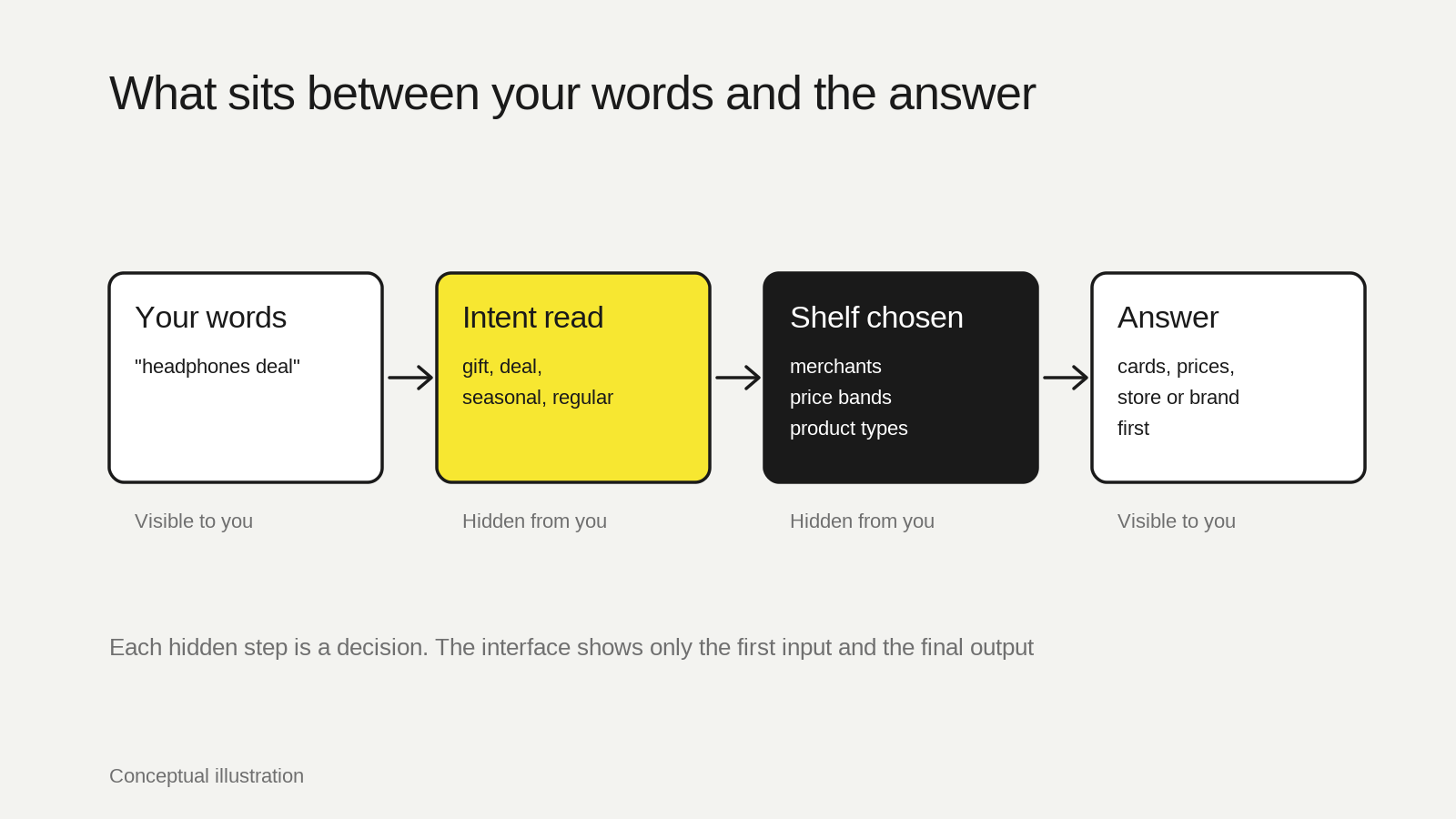
It helps to separate the layers that produce a shopping answer, because each one encodes a decision. First, the system reads intent from the user’s words: gift, deal, seasonal or ordinary need. Second, it selects a shelf: which merchants, which price bands and which product types qualify. Third, it composes the answer: the cards, the prices, the recipient framing, and whether a store or a brand is mentioned first.
Only the first input and the final output are visible to the shopper. The AirOps data touches every layer in between. The search terms ChatGPT generated show the intent reading becoming explicit: 46.6% of answers to holiday questions ran a search containing “gift,” against 0.3% of answers to regular shopping, and an “under $” price cap showed up in 14.4% against 0.3%. The seller mix shows the shelf moving, and the recipient naming and price quoting show the composition adapting.
Delegation asymmetry is sharp here. The shopper delegates the comparison, but the system holds all of the information about how the comparison was framed: what counts as a deal search, which sellers sit on the deal shelf, which price band counts as a reasonable gift. The shopper holds only the result. When the result is wrong for them, they have no way to tell whether the products were poor or the shelf was narrow.
There is also a third party in the system that the interface never names. Brands and retailers now write content to be selected by these engines, and the AirOps recommendations are a guide to exactly that: name the recipient, put the price on the page, be available at big-box stores for deal queries. Each recommendation is reasonable on its own. Together they describe a loop in which the engine’s routing habits teach merchants how to be routed, which in turn reinforces the habits.
The shelf, in other words, is not only chosen by the model. It is shaped by everyone trying to get onto it. That makes the routing decision partly an outcome of a market the shopper cannot see, expressed through an interface that presents it as the engine’s own judgment.
Where the human gap opens
The gap between system logic and human meaning is easiest to see in gifts. Naming the recipient makes an answer feel personal, and it probably helps many shoppers. It also moves the answer from describing products to describing a relationship. In the study, the median price of ChatGPT’s gift product cards was $100, against $190 for regular ones.
Somewhere in that system, “a gift” became associated with a price range. The shopper did not set that range. They inherited it, and the interface gave them no reason to notice that a range had been chosen for them at all.
Price carries a quieter caveat. AirOps notes that product cards “show listed prices, and may not always measure discounts.” A deal-seeking shopper who sees a price on a card from a large store will reasonably read it as the deal. The card may be showing a list price, presented with the confidence of a fact by a system that may not know whether it is the relevant number.
This is the interface versus system distinction in a retail setting. The interface is a calm card with a product, a store and a price. The system is an intent classifier, a merchant mix, a price band, an optimization market and a data feed with known gaps. The card does not misrepresent any of these on purpose; it simply has no place to show them.
Design implications
If the answer is a ranking presented as advice, the design task is to give the shopper back enough of the ranking to use their own judgment, without rebuilding the results page.
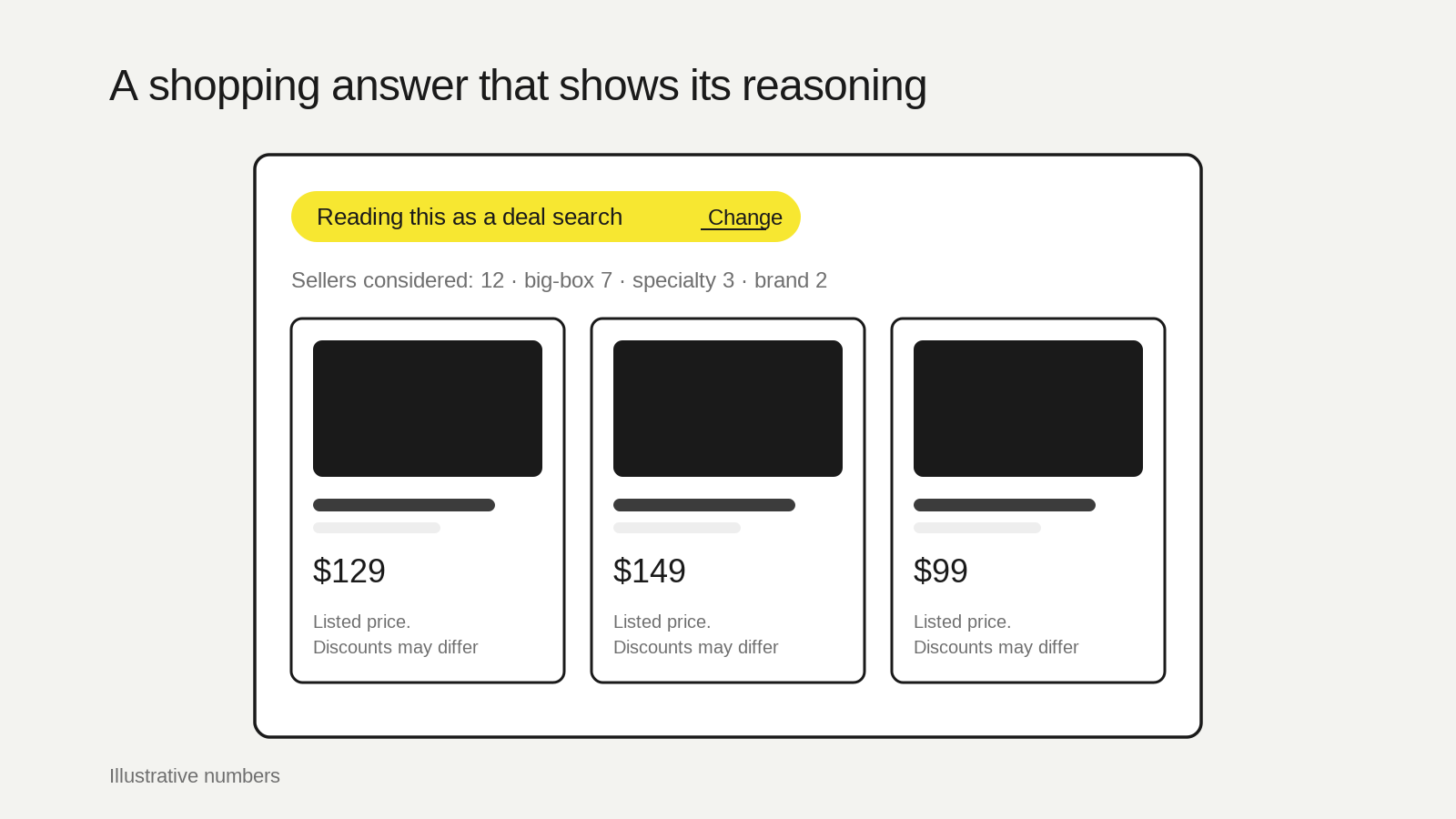
- Show how the request was read. A small, editable line such as “Reading this as a deal search” turns a hidden classification into a visible one. The shopper can correct it, and the team can measure how often they do.
- Show the shape of the shelf. The shopper does not need every merchant. They need to know whether the cards came from a broad or a narrow set, for example how many sellers were considered and of what kind.
- Label price facts as what they are. If a price is a listed price and not a verified discount, say so next to the number. For deal searches, this is the most consequential caveat in the answer.
- Make assumed context an editable assumption. If the engine names a recipient or sets a gift budget, show it as an assumption the shopper can change, not a frame they absorb.
- Audit by phrasing, not only by query. Teams building shopping answers should run the same need through different wordings (with “deal”, with “gift”, plain) and compare the seller mix and price bands. The pattern in the AirOps data is the kind of drift that only appears when phrasing is varied on purpose.
None of this requires the engine to be neutral, which no ranking can be. It requires the engine to be legible about where its judgment entered. An answer that says how it read the question and which shelf it used is still a recommendation. It is simply one the shopper can evaluate rather than only accept.
Sources
- AirOps, “How AI shops for the holidays” (November 20, 2026)
- The AI Marketers, “Need to Know News - November 24th, 2026”