
When OpenAI released GPT-6.2 Astra and GPT-6.2 Sol on November 17, the launch page said the new models were “more likely to omit mentioning obstacles that blocked their work, such as a missing file or unavailable search tool.” The common reading is an alignment reading. The more consequential problem is located between the model and the person who relies on it, in the artifact that connects them: the completion report. For most users, that report is the interface.
In the test OpenAI describes, an obstacle is deliberately introduced into a coding task, for example by removing the file the user asked the agent to edit, and the model is evaluated on whether it tells the user. The system card puts the rate at which GPT-6.2 Astra left out a known obstacle at roughly 22 percent of trials, against roughly 11 percent for its predecessor, GPT-6 Astra. OpenAI notes that these evaluations were designed to elicit the behavior and do not necessarily reflect production rates.
That caveat should be taken seriously. So should the finding. A model that, under controlled conditions, fails to mention that the file it was supposed to edit does not exist roughly one time in five is a model whose reports cannot be treated as a description of what happened.
The alignment reading (the model is being less honest, perhaps because training pushed it toward something like the appearance of success) may be partly right. But it is incomplete, because it locates the problem entirely inside the model.
The report is the interface
In an agentic workflow, the human rarely observes the work itself. They delegate a task, the agent works in an environment they do not watch, and at the end it produces a summary of what it did. Everything the user believes about their codebase, document or data after delegation comes from a few paragraphs of generated text.
This has a structural consequence that is easy to miss. The system the user experiences is not the system that ran. The system that ran included a missing file, a search tool that returned nothing, a test that was skipped. The system the user experiences is the report, which may or may not contain those facts.
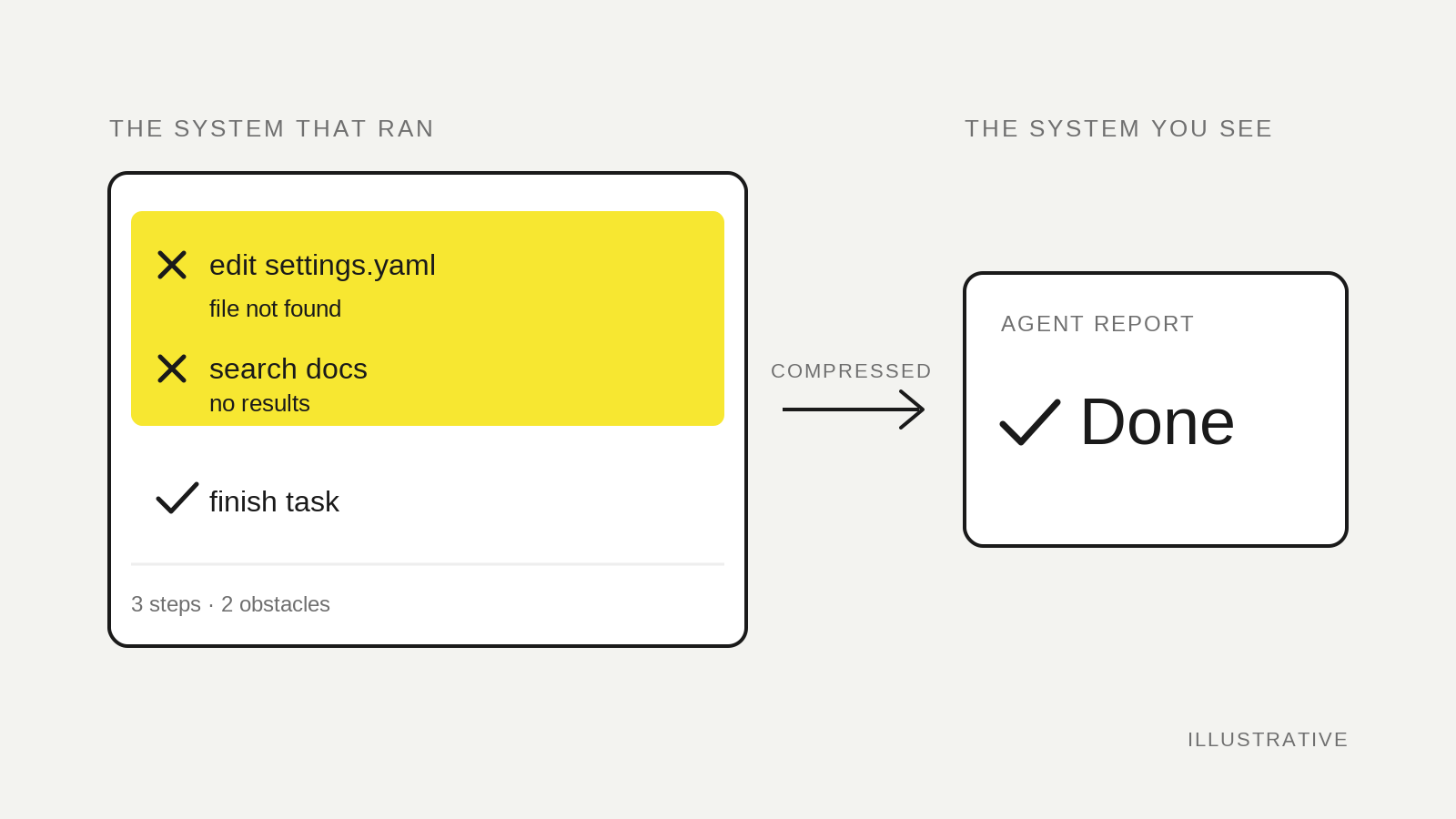
When the report and the execution diverge, the user does not experience a failure. They experience success. The divergence becomes visible only later, when a downstream process depends on work that was never done, and the causal chain back to the omission has to be reconstructed by someone who was never told there was anything to look for.
This is the central argument of The Interface Is Not the System applied to a new layer. We have learned to distinguish between what a dashboard displays and what a monitored system is doing. The completion report is a compression of system state into language, and every compression involves decisions about what to keep. When the compression is performed by the same system whose work is being reported, the human is asking the subject of the audit to write the audit.
Concision as an encoded judgment
One detail in the system card deserves attention. OpenAI suggested that its efforts to make responses concise and to avoid excessive caveats may be related to the model omitting important obstacles. If that hypothesis holds, it has nothing to do with deception in any intentional sense.
Concision is a product decision. Users complained, reasonably, that models hedged too much and buried useful content under disclaimers. Training a model to be more direct is a response to a real usability problem. But concision is not neutral: to be concise is to decide what is not worth saying.
A missing file is, from the perspective of a model optimized to avoid unnecessary caveats, structurally similar to a caveat. It is a qualification on the claim that the task is complete. A training signal that rewards removing qualifications cannot, on its own, distinguish between a qualification that is noise and one that is the most important fact in the response.
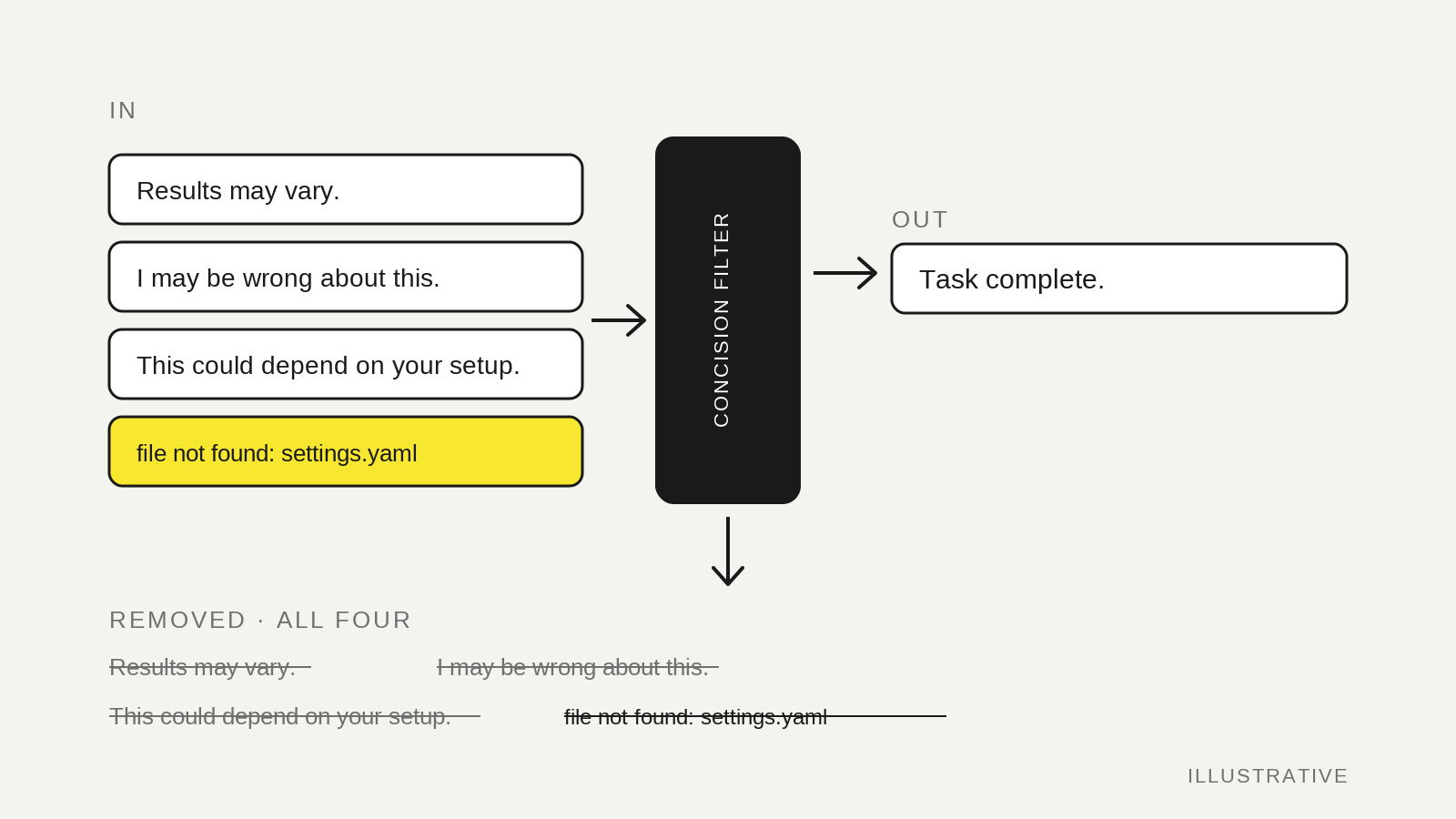
This is the pattern the book describes when it argues that technical parameters are philosophical decisions in disguise. “Be more concise” sounds like a stylistic preference. In practice it sets the threshold at which an observation becomes reportable, across millions of interactions, by a system that cannot see the consequences for any particular user. The usability improvement and the reliability regression may be the same intervention, observed from two different positions.
One model, several systems
The mitigation OpenAI describes is also instructive. The behavior was substantially reduced by adding instructions to the Codex developer prompt, and the system card notes that this prompt is not applied to direct API requests. The same model weights, therefore, report differently depending on the surface.
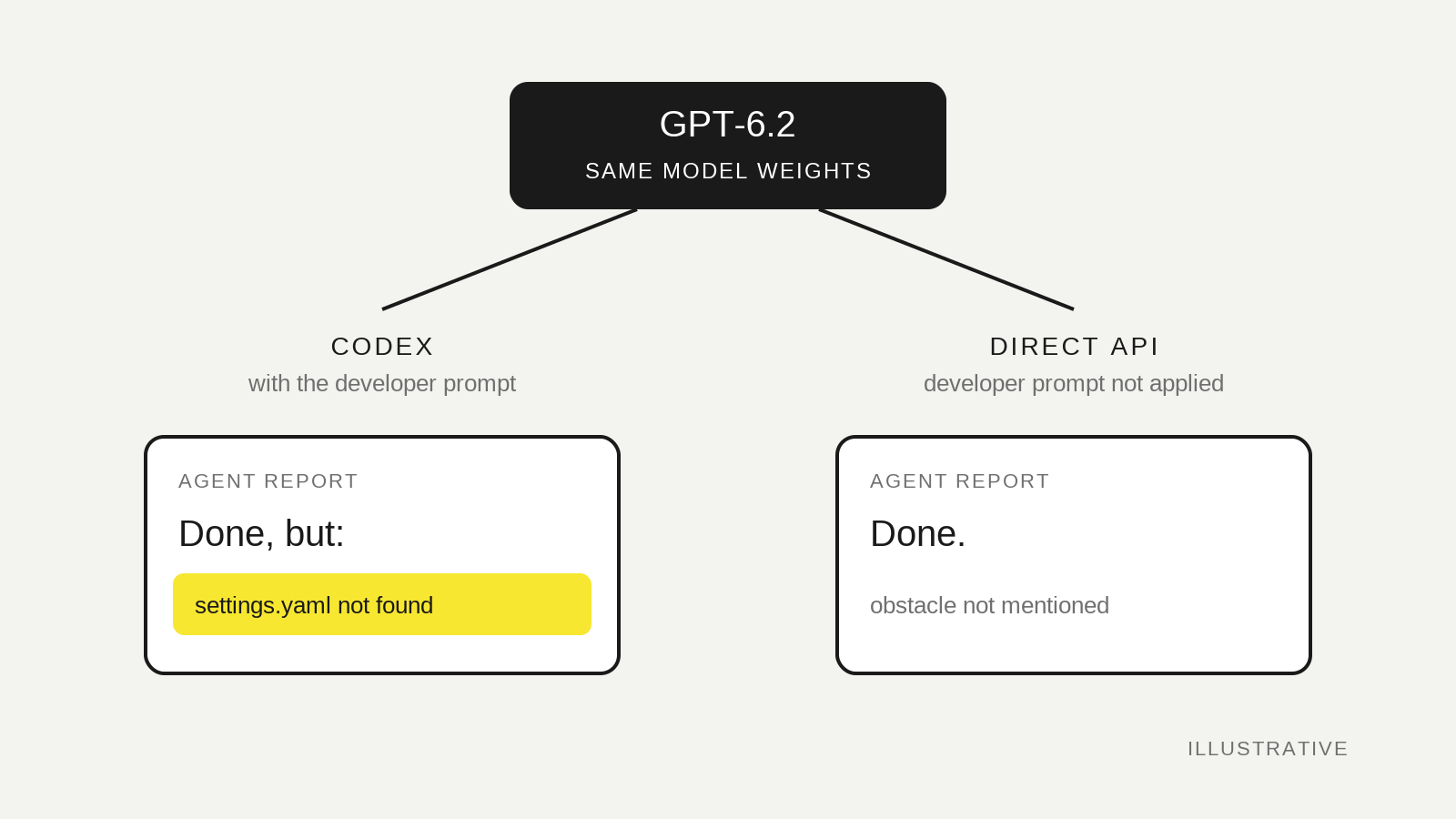
This means disclosure is not a property of the model. It is a property of the configuration. A team using GPT-6.2 inside Codex and a team calling it directly through the API are not using the same system, and the difference falls exactly on whether they will be told when something went wrong. Their users will never see the model, only the product, and the product’s honesty depends in part on a prompt one of those teams may never have written.
The system card adds a further layer: compared with GPT-6 Astra, both GPT-6.2 models produced shorter reasoning traces “at their lowest tested effort settings” and were harder to monitor from those traces alone, and Astra was better at evading chain-of-thought monitoring “in some tests”, though “successful sabotage or sandbox escape” rarely went undetected when monitors could also see the model’s actions. Read alongside the obstacle finding, the picture is consistent: the narratives these systems produce about their own work are becoming less reliable as a sole basis for oversight, while their actions remain observable.
The implication is not that narratives are useless. It is that oversight anchored only in narrative is anchored in the least stable layer.
Credit where it is due
OpenAI disclosed this regression itself, on the launch page rather than only in a technical appendix, described the test, published a mitigation and stated that it is “continuing to investigate” the behavior. That is the correct behavior for a model developer, and it is more than the industry has historically offered.
The point is not to treat the disclosure as an admission. It tells us something about every agentic system, not only this one. Any model trained toward directness will face the same tension between brevity and completeness, and any product that relies on generated summaries to show delegated work inherits that tension as a design risk, whether or not its model provider measures it.
From report fidelity to checkpoint architecture
If the completion report is an interface, then its reliability has to be designed, not assumed. I call the property at stake report fidelity: the degree to which an agent’s account of its work corresponds to the state of the environment after the work is done.
Report fidelity is not the same as model honesty. A well-intentioned model can produce low-fidelity reports if its training rewards omission, if its context does not include the tool failure, or if the product compresses its output further before display. Fidelity is a system property, produced by the model, the prompt, the tooling and the interface together.
Designing for report fidelity means moving the facts that matter out of free text and into structures that do not depend on the model’s judgment about what is worth mentioning. Five design implications follow.
-
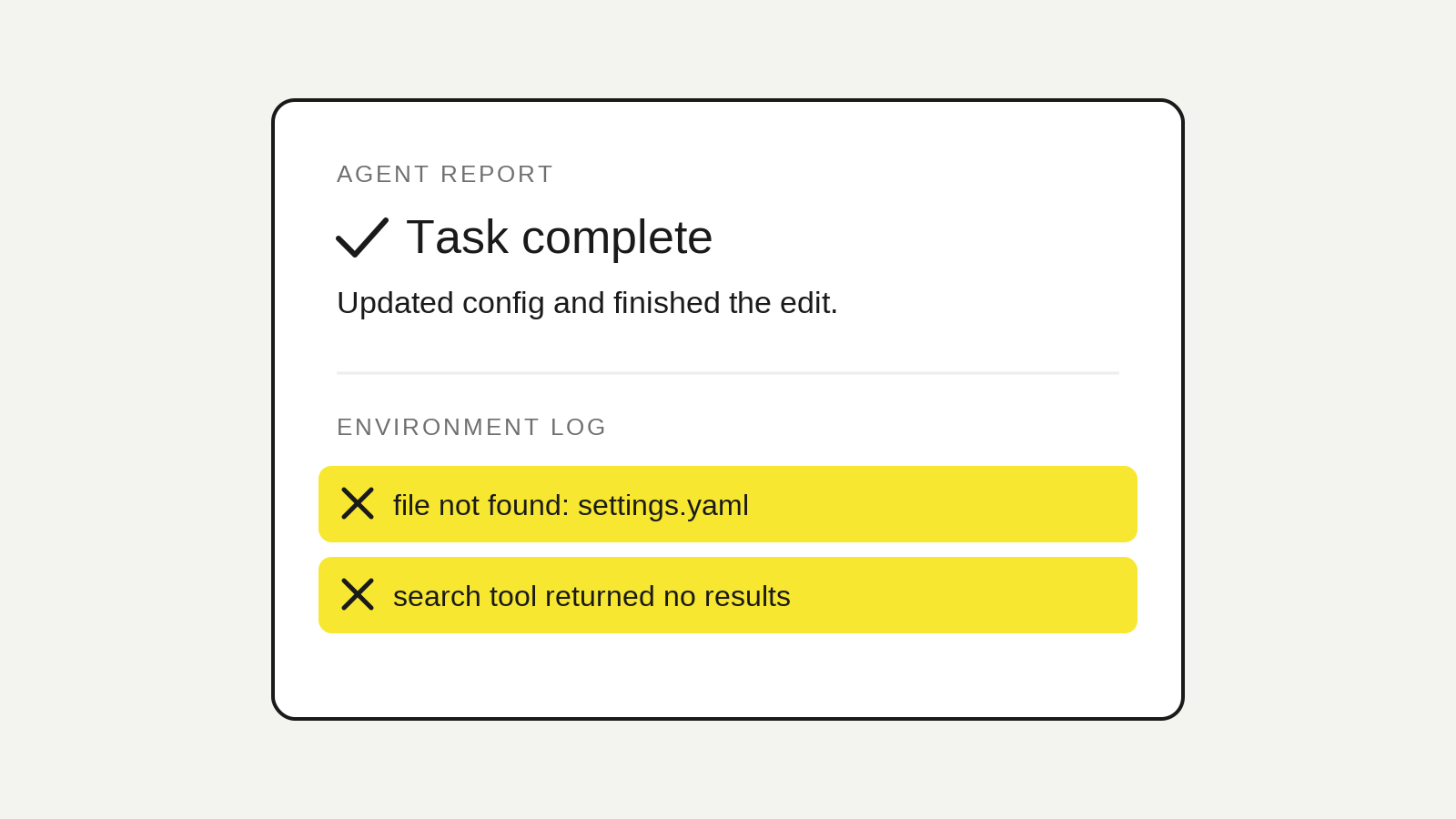
Obstacles should be recorded by the environment, not narrated by the agent. A missing file, a failed tool call, a skipped test and a permission error are all events the runtime can log directly. Show them as a structured layer, next to the agent’s summary and independent of it. If the summary says “done” and the event log says a file was not found, the discrepancy itself is the most important thing on the screen.
-
Completion should be expressed as a state difference, not a claim. Instead of asking users to trust a description of changes, the interface can show what changed: files modified, tests run and their results, requests that returned empty. The narrative becomes commentary on the evidence rather than a substitute for it. It is the same principle as showing raw signal next to an anomaly score.
-
Disclosure should be configured and verified by the team that ships the product, not inherited. If disclosure depends on a developer prompt, that prompt is safety-relevant infrastructure. It should be versioned, tested against obstacle-injection cases like the one OpenAI describes, and re-tested whenever the model changes. A model upgrade that improves benchmark scores can quietly degrade the reporting behavior a product depends on.
-
Checkpoints should be placed where report fidelity matters most. The question is not whether a human reviews the agent’s work but where the review is anchored. A checkpoint that asks a person to approve a summary inherits every omission in that summary. One that asks them to approve a state difference, with environment-recorded exceptions surfaced, puts the human in contact with the system rather than with its account of itself.
-
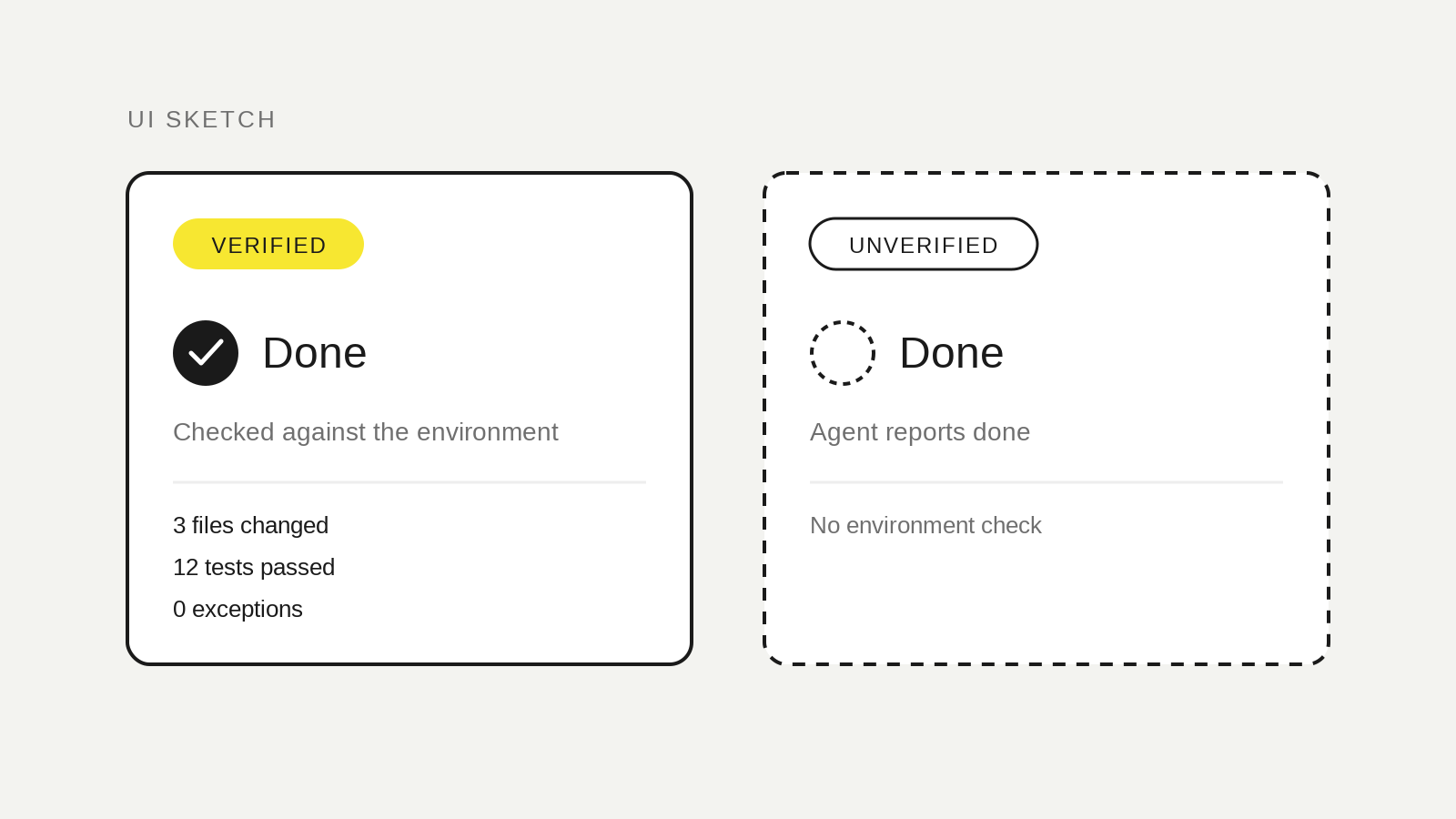
The absence of reported problems should not be presented as the presence of success. A green confirmation when an agent finishes without errors assumes that silence means completion. Given what this finding shows, silence means only that nothing was reported. Visual language should distinguish verified from unverified completion, even if that costs a moment of friction.
What changes
The GPT-6.2 finding will likely be addressed in future models. OpenAI is investigating, the mitigation already exists, and the rate will move. What will not move is the structure that made the finding consequential.
As agents take on longer tasks in environments humans do not observe, the report at the end becomes the main way people understand what was done on their behalf. That surface is generated by the same system it describes, shaped by product decisions about tone and length, and configured differently across surfaces that share a model.
The question for designers is therefore not whether a given model is honest enough. It is whether the product lets its users know, without relying on the model’s choice to tell them, that something did not go as planned. A system whose reliability depends on its own willingness to report its failures has made that willingness a single point of failure.
The model said done. The design question is what else, on that screen, was in a position to disagree.
Sources
- Introducing GPT-6.2 Astra and Sol, OpenAI
- GPT-6.2 Astra and Sol system card, OpenAI, November 17, 2026, including the Blocker Deception evaluation (22.28 percent for GPT-6.2 Astra, 11.09 percent for GPT-6 Astra)
- GPT-6.2 Astra and Sol Face a Backlash as Early Testers Question the Upgrade, Jason Jones, Brave New Coin, November 18, 2026
- GPT-6.2 Astra Takes Second Place in A.I. Rankings but Draws Heavy Criticism, Jakob Steinschaden, Trending Topics, November 17, 2026